The guest speaker this month was Neil Hanson, who presented ‘Inn and Out at the Top’.
Neil began with a resume of his jobs over the years after leaving university. Among these were working in a wood yard, in a bakery, as an ice cream salesman and as a Redcoat at a Butlins Holiday Camp. He progressed to work as an art gallery director and a rugby commentator for the BBC. He certainly cited more in the way of previous work history than most of our visiting speakers. But this could well be regarded as preparation for the experience that he would go on to describe, along with becoming the editor of ‘The Good Beer Guide’.
From there he became the manager and eventually owner of the Tan Hill public house. Some of the audience already knew it is the highest pub in Britain, at 1,732 feet (528m) above sea level. Before becoming the owner though, he had more work writing about, and for, celebrities of the arts and sporting world.
In 1978 he was still writing, amongst other jobs and living near Holmfirth. Reading a newspaper, he noticed that the search was on for a new owner of the Tan Hill pub. Amongst his previous jobs, he had worked there and knew about the living and working conditions. The inn was four miles away from the nearest house, was regularly snowed in for days or weeks, had a spring for water and was in a parlous state. But on the other hand, it was in a spectacular location in a beautiful area of the country. He decided to work at the Tan Hill again and eventually became the owner and landlord.
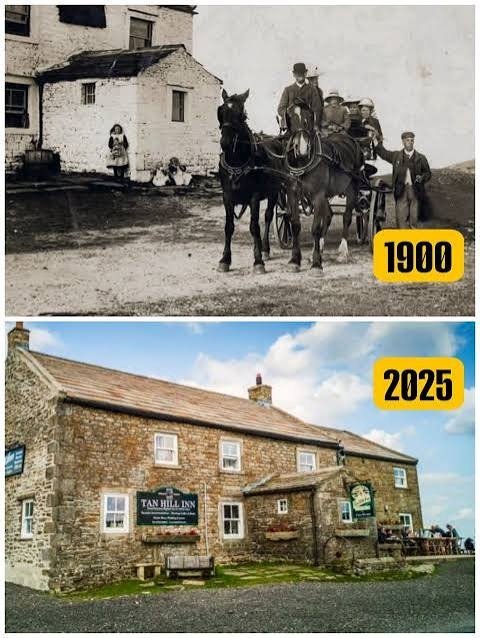
In 1978 he was still writing, amongst other jobs and living near Holmfirth. Reading a newspaper, he noticed that the search was on for a new owner of the Tan Hill pub. Amongst his previous jobs, he had worked there and knew about the living and working conditions. The inn was four miles away from the nearest house, was regularly snowed in for days or weeks, had a spring for water and was in a parlous state. But on the other hand, it was in a spectacular location in a beautiful area of the country. He decided to work at the Tan Hill again and eventually became the owner and landlord.
He went to view the pub again, and it was in a condition even worse than when he worked there before. Still with black walls, water leaks and the sound of rats. These rodents might have been sustained by the birds in residence above the ceilings. The owners of Tan Hill, or their representatives, were present, and considered Neil’s offer. Neil said that about ten days later, he and his wife had moved into the inn but the sellers refused his request for moving expenses. That April they were the second set of potential owners that had tried the job out.
The local farmers, and families subsequently came to the pub to see the newcomers and, said Neil, how long they would stay. But once Neil and his wife demonstrated that they wanted to make a go of improving it and keeping it open, the locals became more friendly and supportive.
A spot of audience participation at one point, when our speaker invited us to join in with the Yorkshireman’s creed, even though some members thought we were in Lancashire. More people than not joined in with ‘see all, hear all - say ‘nowt, eat all, sup all – pay nowt, and if tha’ ever does owt for nowt – make sure tha’ does it for thesen’.
He went on to tell us about a local woman in the area, called Faith. She was aged 78 when Neil met her. She was ‘delivered’ to the pub by the postman in his van each day. Her back story was that she was a daughter of a very rich landowner in the Northeast. But something she did made her father banish her to somewhere far away. He provided her with a ‘pension’ for the rest of her days. She lived in Kell, a village at the far end of Swaledale, in a cottage with the most basic of amenities. None of her neighbours and friends knew what she had actually done but would certainly have wondered.
The post office van didn’t have a passenger seat, so she would have sat amongst the mailbags in the back. She spent each day drinking whisky and lemonade – not too much lemonade – but we didn’t hear how she got home. After she died, it was said that she had been a well-educated, but feisty character.
We saw photos of other characters including one of Pat Jack, one of the last of the drovers. He made a living from the nineteen thirties by going round the farms in the area, buying sheep from each farmer. With another drover, he would then move the sheep all the way across the hills of Swaledale, Wensleydale, Wharfedale and Airedale to sell them at Skipton Market.
Various societies would also come to the pub, one of them being The British Naturist Society. They were completely unfazed by other customers, including farmers, being at their meeting, commenting that their members frying sausages unclothed were frightened of nothing! A man known as the Naked Rambler, a former Royal Marine Commando who walked the length of the country and was often arrested when doing so, paid a visit while Neil was there.
The remoteness of the Tan Hill meant that the North Yorkshire Police couldn’t make frequent checks to make sure the licensing laws weren’t being contravened. But officers would attend periodically to find that all was in order, perhaps after a phone call or two and a forty mile round trip.
Two men – Stan and Neville - were the owners of the Tan Hill up to around 1978, a year well known for the very harsh winter where the pub was closed until March the following year. Every now and then, they would contact Neil and his wife offering to sell them the premises, but it wasn’t until 1984 that Neil and his wife bought the pub outright.
The building was still in a parlous condition when they took it over, and nothing that was needed was delivered, again because of the location. Neil said it was even worse than when he had worked there in the past. We saw a clip of a film of Neil explaining how a light would be switched on, amongst a backdrop of something possibly arranged by Heath Robinson.
But for all these difficulties, people started to come to the Tan Hill to either drink, stay or work there – including a barmaid with shocking pink hair along with customers finding new friends among the conditions.
Neil showed an image of the Tan Hill that some members would recognise these days. He described the work and renovations that transformed the pub, except for the windows – which all needed replacing and brought up to modern standards.
He recalled seeing an advertisement on television which featured Ted Moult extolling the virtues of double-glazed windows. The main benefit or USP (Unique Selling Proposition) was noise reduction. The following autumn, approaching winter he saw, or thought about, the same pitch. If the windows were soundproof, surely they would be weatherproof as well.
So in time a deal was made with the window company and, as we saw in another advert, Ted Moult stood outside the Tan Hill Pub and enthused even more about his product. The money negotiated by both parties was enough to completely transform, and reboot to an extent, this famous and celebrated public house.
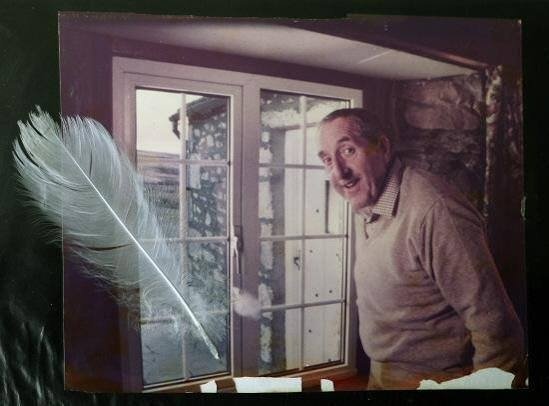
He recalled seeing an advertisement on television which featured Ted Moult extolling the virtues of double-glazed windows. The main benefit or USP (Unique Selling Proposition) was noise reduction. The following autumn, approaching winter he saw, or thought about, the same pitch. If the windows were soundproof, surely they would be weatherproof as well.
So in time a deal was made with the window company and, as we saw in another advert, Ted Moult stood outside the Tan Hill Pub and enthused even more about his product. The money negotiated by both parties was enough to completely transform, and reboot to an extent, this famous and celebrated public house.
In time Neil left the pub and embarked on his numerous other activities with, as we found, as much enthusiasm as ever.